
 The journey to buying your cruising boat is every bit as thrilling—and daunting—as casting off the lines for the first time. That’s why having someone like Captain Jay Williams in your corner makes all the difference. With a lifetime on the water, from running liveaboard dive vessels in the Bahamas to managing new builds in Italy and overseeing complex yacht projects worldwide, Jay brings uncommon technical expertise, calm leadership, and a deep commitment to his clients' best interests. His hands-on experience, problem-solving skill, and ethical approach ensure your purchase process is not only efficient and well-managed but also genuinely enjoyable as you take the next step toward your dream.
Captain Jay Williams
(305) 788-1121
About Jay Williams
True Story:
A north wind whistles overhead as we sit at Bahia Mar in Fort Lauderdale. We can see the waves from the beach, like circus elephants walking trunk to tail on the horizon. Huddled at the pool bar, we feel the temperature drop by the hour.
On the VHF weather channel, Perfect Paul says: Wind North 20 to 25 knots, gusting to 30. Seas 12 to 14 feet with occasional seas to 18. Small craft advisory in effect.
After 9pm, Wind North Northeast 25 to 35 knots. Seas 15 to 25 feet. Gale warning in effect.
One intrepid yacht leaves the dock, trying to get ahead of the heaviest weather. As it goes by, the captain shrugs at me. They never learn, his body language says. It limps back to the marina a few hours later, a hull window broken in and the entire radar stripped off the mast. The bilge pumps are running nonstop as the captain calls ServPro to help control the water damage.
The local news cuts to a cruise ship that lost power out in the Stream, got broadside to the waves and had a grand piano slide across the dining salon. A side window broke, letting the sea inside. We see video of terrified passengers washing around the room in the remains of the buffet dinner.
A cruising couple with a mid size trawler shake their heads. “We’re never going to get a weather window,” he says. His wife is too quiet, probably thinking of just flying out and giving up this part of their Great Loop trip. Another boater at the pool bar pipes up. “Just wait until it goes West,” he assures them, “Then it’s downhill all the way.”
This is where I can’t stop myself from breaking into the conversation, preventing a terrible situation. “Actually,” I say, “You want the wind to be Southeast to East when you cross. Right on the nose. Otherwise, you’re going to get caught by the next front.”
Why would I say that? How is it safer to beat your way across with the wind on the nose? With a 6-knot trawler, the cruising couple were going to get caught by the next front if they left when the wind was west.
The most important thing about crossing the Gulf Stream is understanding the weather patterns and the tactics to deal with it.
What, exactly, is the Gulf Stream?
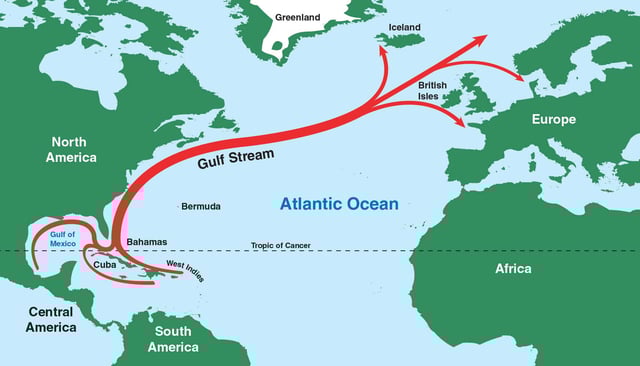
I once heard the Stream referred to as the Blue God, and it stuck. The Gulf Stream is a warm ocean current that’s born in the Caribbean, moving north along the coast of the Eastern Seaboard and eventually slinging across the Atlantic, splashing against the British Isles.
In many ways, the Blue God is responsible for much of European civilization as we know it today. The Gulf Stream’s warm, nutrient-rich water warms the islands and mainland of central and southern Europe, creating a climate that is hospitable to farming. It nourishes great schools of fish and whales, warms Iceland to a habitable level and creates weather all along its length.
As it passes the eastern US, the Gulf Stream moves north at an average of about 4 knots. It can be as much as 15-20 degrees warmer than the surrounding North Atlantic. As a result, it creates and accelerates weather: in the summer, it works to intensify and direct hurricanes, while in the winter it creates a set of conditions in the Straits of Florida, off Cape Hatteras and near Nova Scotia that are very challenging for boaters.
Why is it so rough out there?
Most of the year, it’s not. Throughout the summer, prevailing Southeast Trades make for a snotty crossing at times, but (aside from hurricanes) there’s not much effect on the seas.
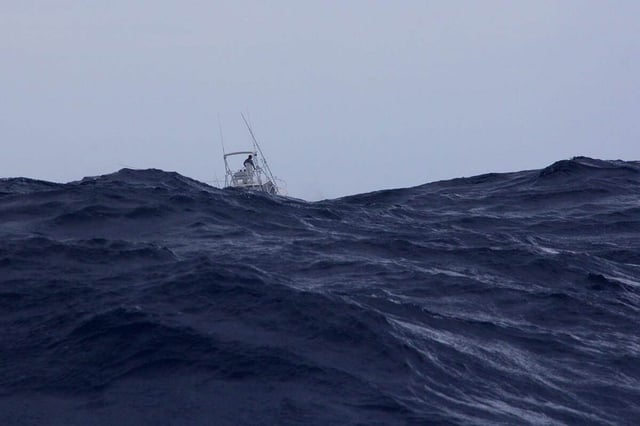
Winter is a different story. During the winter, cold fronts from the Northeast and the Rockies sweep down into Florida, causing a rotating wind shift that can stir the Stream up into a frenzy. It’s no surprise that so many Bermuda Triangle disappearance tales start with a “nice day in Florida with a light wind out of the west.”
When the wind is blowing out of any Northern quadrant: Northeast, Northwest or North, the wind pressure against the Gulf Stream’s current magnifies wave heights. A 20 knot Southeasterly wind will yield 4-6 foot chop, but a 20 knot Northerly wind might create wave heights of 15 feet or more.
How do these fronts progress?
The prevailing wind in South Florida is East in the winter, or East Southeast.
- Front Approaching: As a front approaches, the wind will “clock” towards the South. This is a warning sign to experienced Gulf Stream hands, we find reasons to get to the dock. This period can last a day in the winter, or as little as a few hours in spring.
- Frontal Passage: The wind will turn to Southwest, then West as the frontal boundary crosses. This is often accompanied by thunderstorms, rain, squalls and even snow. This phase can last a day or two in late fall, or pass by quickly in spring. The wind will accelerate as well as it continues to shift into the Northwest. At this point the Gulf Stream will start to get spicy. Our trawler couple will slow down to accommodate the seas as conditions deteriorate. They’re now firmly in the danger zone.
- High Pressure: A high pressure system is now sitting to the north, pouring wind down into the low of the front. The wind shifts to full north and ramps up. 20 knots, then 30; a deep November or December front can carry winds near 70 knots. Temperatures plunge by as much as 40 degrees. Pushing against the Gulf stream, the waves become huge. They are short and steep, with breaking crests. When winds are directly out of the North, over 40 knots, the sea state in the Straits of Florida will exceed 40 feet. This phase of the frontal passage can last as long as a week. Winds will shift to Northeast, then slowly back to East.
- Prevailing: As the high pressure system recedes to the south, the prevailing East winds will fill back in. They may be strong, but they’re blowing across, instead of against, the Stream. This is the time to leave the dock, as long as there’s not another front forecast to hit right away. Leaving for the crossing during the Easterly Prevailing phase gives sailboats and trawlers the maximum safety window to cross.
- Veering and Stacked Fronts: Look out for fronts that are packed tightly together. Sometimes they can overlap and merge, forcing the wind to veer back to West, or North. Pay attention to the forecast wind directions, they will tell you what you need to know about what is happening and when.
Tactics (South Florida to Bimini)
- Displacement Trawlers: Leave as soon as possible after the wind returns to East. Steer 10-12 degrees south of your rhumb line for the most efficient crossing of the Stream’s current.
- Sailboats: Consider repositioning the boat as far south as is practical for a trip from Miami or Lauderdale to Bimini and the Bahama Bank. This will give you a better point of sail, hopefully avoiding motoring. Leave as soon as possible after the wind returns to East. Key Largo is a good choice as a departure point. If you have a big engine or a large sailboat, it’s often more practical to just leave Miami or Lauderdale and head across like a trawler. Avoid the temptation to sail across in a Westerly, unless it’s forecast to last more than long enough for you to make your destination.
- Fast Yachts: motoryachts and semidisplacement trawlers: With a cruising speed of 18-25 knots, you have a lot more flexibility. Avoid any wind with a northerly component. Even 15 knots of Northeast will create a surprisingly nasty sea state. Add 30% to your expected transit time when looking at weather forecasts.
Bimini Considerations
- In any Westerly or Northwesterly through Northeast wind, the entrance to North Bimini can easily be closed by waves breaking on the Henry Bank. This is extremely dangerous, and should be avoided whenever there are breaking waves on the Henry Bank.
- You can steer north of the island, passing around North Rock onto the Great Bahama Bank, then transiting across to Northwest Channel, clearing Customs inbound at the port of your choice in the Berry Islands or Nassau. For sailboats who are struggling to hold a sail in the prevailing, this is often the best way to go. **The Bahama Bank is littered with coral heads and wrecks, you should transit in good light only.
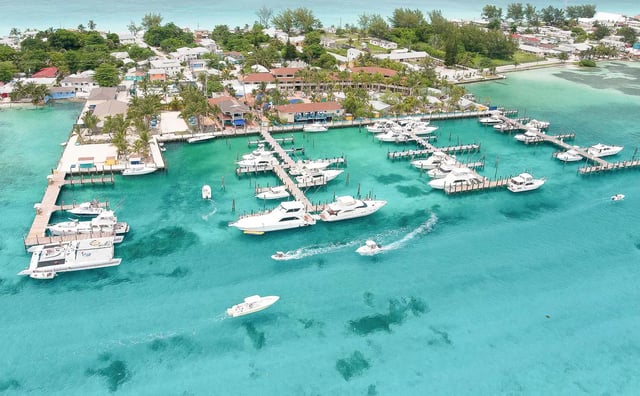
- You can also pass through Gun Cay Cut, with safe anchorage behind Gun Cay. If Bimini is your destination, this should be the goal. Note the reefs extending north from North Cat Cay, hug the Gun Cay side. The lighthouse is often not lit. There’s passage for shallower draft (5.5 feet or less) boats all the way to South Bimini and Nixons Harbor if you want to wait out the front. For boats with drafts well under 6 feet, it’s possible to travel up the “back” to the deeper part of the Bahama Bank, picking up the rhumb line between North Rock and Northwest Channel. Look for Larks Two Fathoms Bridge on your chart as you leave Gun, you’ll pass close to that point as you work your way behind Bimini.
Here’s a little mantra I say to myself and others: North means No. Don’t go. West means Wait, it’s going to go North. South means Stay Cautious. East means Easy Day.
Boat Preparation:
- Make sure everything is tied down, inside and out. Anything loose will find its way off the shelf.
- Stow all dock lines and fenders, completely removing them before the boat leaves the safety of the harbor. It’s surprising how many boats have lines wash over and get tangled in the prop.
- Wear a safety harness PFD and require your crew to do so as well. What’s worse than being beat up in the Stream? Watching the boat disappear into the dark as you tread water. It’s a lonely feeling.
- Listen to the NOAA weather forecasts on your VHF radio.
- Subscribe to a towing service, like SeaTow or Towboat US
- Because the Stream’s current provides a boost to ships, it can be a very crowded stretch of water. Check your AIS and GMDSS system before you go.
The Bahamas are one of the world’s greatest cruising destinations. With over 880 islands, rocks and cays, there’s a lifetime of exploring to be had, but a thin ribbon of purple blue water stands in the way. In good weather, you could cross the Gulf Stream in a RIB dinghy, and people have. In bad weather, the piano slides across the cruise ship’s dining hall.
Watch your weather, using an app like Sailflow or Windguru (or many others). Gulf Stream winter weather is as predictable as a clock, once you understand.
Enjoy the Bahamas!
Would you like some personalized advice about crossing the Gulf Stream and visiting the Bahamas, or guidance on finding the right boat for a Bahamas trip? Contact Captain Jay Williams






LEAVE A COMMENT